
CN | EN
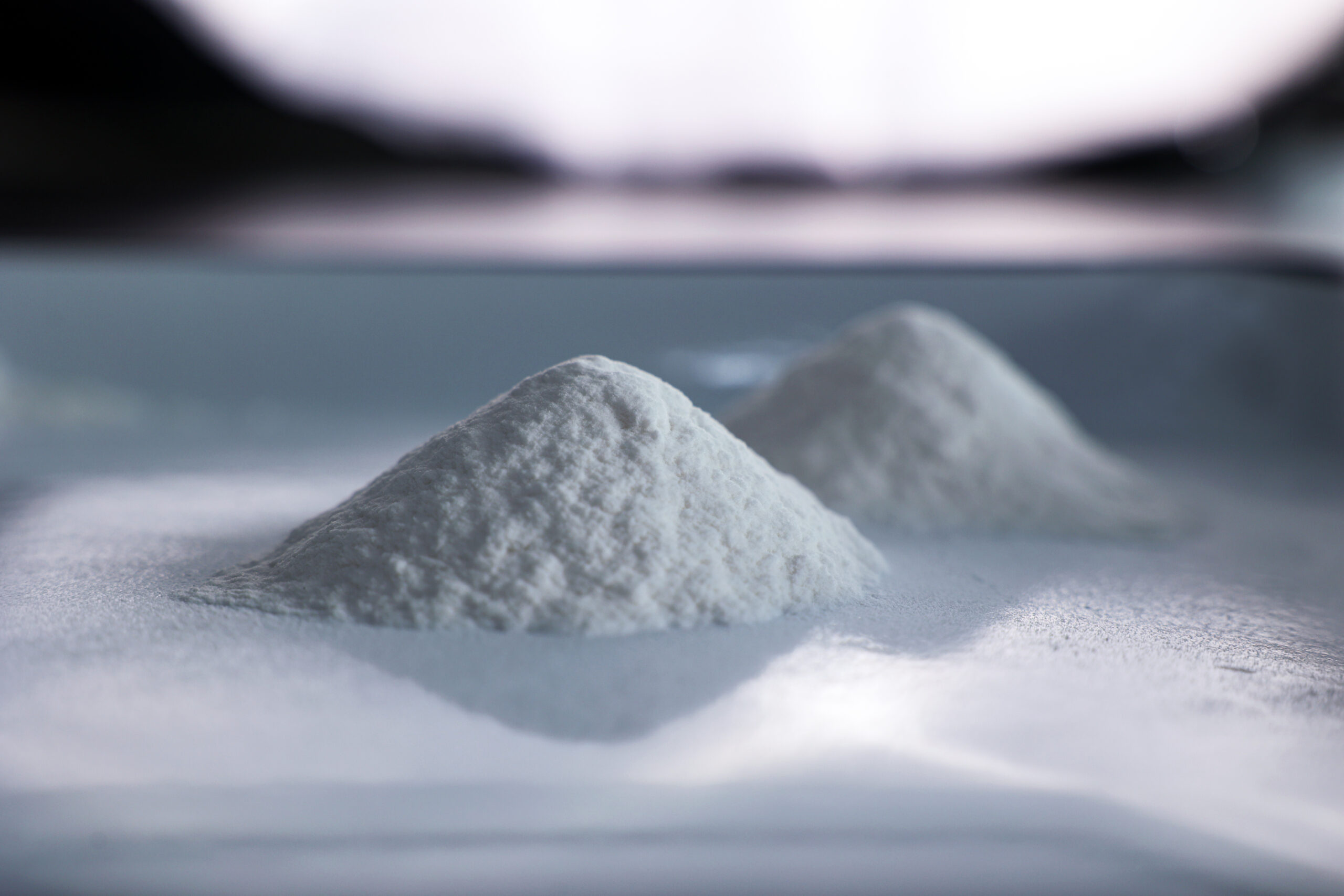

1. The Short Answer: CMC Is Not “One” Additive but a Bundle of Properties
Sodium carboxymethyl cellulose (CMC, international food additive number E466) is often called a “universal additive.” That label is not quite right. It isn’t that CMC can do everything — it’s that its molecular structure gives it several functions at once, so it plays a different role in every industry.
The same E466 is the anti-icing agent in an ice cream plant, the anti-separation agent in a toothpaste plant, the body-building thickener in a soy sauce plant, and the anti-flaking agent in a lithium battery plant.
One bag of white powder, four identities. That is the key to understanding CMC: the properties are fixed; the application is what changes.
Below, the seven core properties are unpacked one by one, each answering two questions — what is the mechanism, and where is it used.
2. Seven Core Properties: From Mechanism to Application
Property 1: Thickening — and It Gets Thinner the More You Stir
Once dissolved in water, the carboxymethyl groups on the CMC chain dissociate and carry a negative charge. Like charges repel, forcing the polymer chains to extend fully and form a hydrated network that occupies a large volume — macroscopically, viscosity rises sharply. A 1% aqueous solution can reach several thousand mPa·s, which is the basis of its role as a thickener.
But CMC’s thickening has a distinctive feature: pseudoplasticity, or shear thinning. Viscosity is high at rest; the moment you stir, pump, or pour, it drops — and then recovers when left to stand. That produces two practical benefits:
- Sauces and beverages are easy to fill and easy to pump, with no clogged lines;
- In the mouth, chewing shear makes the liquid thinner, so the texture doesn’t turn gluey.
Where it lands: sauces, juices, dairy beverages, dressings, toothpaste, detergents.
Property 2: Suspension — Holding Particles in Place
The three-dimensional network formed by a CMC solution has a yield value, which can hold insoluble solids and oil droplets in place and slow both settling and creaming. Suspending power correlates with viscosity but is not identical to it — for some systems, a low-viscosity, high-suspension grade outperforms a simply high-viscosity one, because it holds the particles without making the system too thick to handle.
Where it lands: pulp beverages (suspended fruit pieces), chocolate milk, ceramic slurries, pesticide suspensions, battery slurries (preventing active material from settling).
Property 3: Emulsion Stabilization — Not an Emulsifier, but It Makes Emulsions Hold
CMC is not a strong emulsifier in itself; it is a protective colloid. It adsorbs at the oil–water interface to form a charged hydrophilic film, and simultaneously raises the viscosity of the continuous phase, making already-dispersed oil droplets far less likely to coalesce again.
This property pays off in two situations in particular: the long-term stability of dairy and plant-protein beverages, and ice cream — where CMC suppresses ice crystal growth so the product doesn’t develop a coarse, icy texture when the cold chain fluctuates, while also improving melt resistance.
Where it lands: dairy beverages, plant-protein drinks, ice cream, salad dressings, cosmetic emulsions.
Property 4: Water Retention and Anti-Staling — Locking Water Into the System
CMC’s hydroxyl and carboxymethyl groups are strongly hydrophilic and can convert free water into bound water through hydrogen bonding, reducing moisture migration and evaporation. In the finished product this shows up as:
- Bakery and noodle products: starch retrogradation (staling) is delayed, so the product stays soft after three days;
- Meat products and frozen foods: less purge loss on thawing, higher yield;
- Ice cream: ice crystal recrystallization is suppressed, giving a finer texture.
Where it lands: bread and cakes, frozen dough products, processed meat, ice cream, pet food.
Property 5: Film Formation — Brushing Out a Clear Film
On drying, CMC forms a continuous, transparent, flexible film that is edible, water-washable, and better at blocking oxygen than a starch film. Industrially, this film-forming ability is used for paper surface sizing and textile warp sizing, improving surface strength and smoothness.
Where it lands: food preservation coatings, tablet coating (with other excipients), paper sizing, textile warp sizing, 3D-printing paste forming.
Property 6: Binding — Holding Powders Together
CMC is an excellent water-soluble binder, widely used in two areas: tablet granulation and battery electrodes. In lithium-ion batteries especially, CMC works alongside SBR to disperse graphite and conductive additive evenly and adhere them to the copper foil — CMC’s dispersing capability directly determines slurry consistency and electrode adhesion.
Where it lands: pharmaceutical tablets, lithium-ion anodes, ceramic green bodies, coal briquettes, feed pellets.
Property 7: Acid and Salt Tolerance — A Conditional Property
This is the most overlooked — and the most troublesome — item on the list. Standard CMC precipitates or loses viscosity sharply in acidic conditions (pH below roughly 3–4) or in high concentrations of divalent salts (Ca²⁺, Mg²⁺), because the carboxymethyl anions bind with hydrogen ions or divalent cations.
But acid and salt tolerance can be improved: the higher the degree of substitution and the more uniform its distribution, the stronger the tolerance. High-DS grades (DS above 1.0) stay stable in systems around pH 3 and at relatively high salt concentrations.
This property drives selection directly. If your formulation is itself acidic or high-salt (acidified beverages, soy sauce, drilling fluids, some battery slurries), a standard grade will not work — you need an acid- and salt-tolerant type.
3. The Four Parameters Behind These Properties: Why “All CMC” Differs So Much
CMC’s seven properties are not fixed values. They are scaled by four parameters:
| Parameter | Properties affected | How to think about it |
| Degree of Substitution (DS) | Solubility, acid/salt tolerance, clarity, stability | Higher DS means fuller dissolution and better acid/salt tolerance; food grade typically 0.6–0.95, high-tolerance grades 1.2 and above |
| Viscosity | Thickening, suspension, water retention | Low/medium/high series; higher viscosity thickens more, but too high hurts flow and mouthfeel |
| Purity | Clarity, safety, dosage | Insufficient purity means more residual salt — lower light transmittance and a forced increase in effective dosage |
| Particle size and dissolution speed | Dispersibility, caking | Fine particles dissolve fast but dust and clump; instant grades are surface-treated for better dispersion |
A one-line memory aid: DS decides whether you can use it, viscosity decides how much you use, purity decides whether you dare use it, and particle size decides whether it’s easy to use.
4. Matching Properties to Applications: A Selection Table
| Problem you need to solve | Properties to prioritize | Selection direction |
| Sauce too thin, won’t cling | Thickening + pseudoplasticity | Medium-high viscosity, DS 0.7–0.9 |
| Fruit pieces settling, separation | Suspension + yield value | Medium viscosity, uniform dissolution |
| Dairy beverage separating on standing | Emulsion stabilization + water retention | Medium viscosity, high purity |
| Ice cream icy, poor melt resistance | Ice crystal inhibition + water retention | Medium-high viscosity, food grade |
| Bread hard after two days | Water retention + anti-staling | Medium viscosity, food grade |
| Precipitation in acidic beverages | Acid tolerance | High DS (above 1.0) |
| Cloudiness in soy sauce or brine | Salt tolerance | Salt-tolerant type, high DS |
| Lithium electrode flaking | Dispersion + binding | Battery grade, ultra-low impurities |
| Toothpaste separating, unstable paste | Thickening + salt tolerance | Toothpaste grade, high purity |
Take this table straight into a conversation with your supplier. Explaining “what problem I need solved” is far more effective than saying “I need CMC.”
5. Five “Property Traps” in Actual Use
Knowing the properties isn’t enough — apply them wrong and you still fail. These five traps are the most common:
- Pouring powder straight into water. The outer layer swells first and traps dry powder inside, forming “fish eyes.” The correct method is to pre-blend with dry ingredients such as sugar or salt before sprinkling in, or add slowly into the vortex of a stirrer.
- Assuming higher viscosity is better. Overdosing produces a gluey mouthfeel, coating difficulties, and higher pumping energy. Use just enough viscosity — stability matters more than height.
- Ignoring pH. Putting a standard grade into an acidic system leads to precipitation and separation during shelf life.
- Ignoring divalent salts. Where calcium or magnesium ions are present (dairy, some mineral water formulations), standard CMC crosslinks and precipitates.
- Skipping the bench trial and going straight to production. CMC behaves very differently across systems — no matter how impressive the COA, it cannot replace one bench trial.
6. Safety and Regulatory Status: A Property You Can’t Skip
As a food additive, CMC’s safety record is itself one of its most important properties:
- International food additive number E466;
- The FAO/WHO listed it among safe additives as early as 1963, with an Acceptable Daily Intake (ADI) of “not specified”;
- In China it is governed by GB 1886.232-2016, the National Food Safety Standard for Food Additive Sodium Carboxymethyl Cellulose, which sets requirements for purity, DS, viscosity, moisture, pH, heavy metals, and microbiology;
- CMC is not digested or absorbed by the human body; it passes through and provides no calories.
This is also why certifications must be checked when choosing a supplier — under the same chemical name, food grade and industrial grade are controlled to completely different levels for heavy metals, arsenic, and microbiology.
7. Fortune Biotech: Turning These Properties Into Adjustable Parameters
Once the properties are understood, the real difficulty becomes: who can reliably “dial in” those properties to your requirement?
That is precisely where Fortune Biotech (Jining Fortune Biotech Co., Ltd.) adds value — it turns the properties above into selectable parameters:
1. More than four decades doing one thing: cellulose ethers. Its origins trace back to the Yutai Chemical Plant, founded in 1970 in Shandong. In 1979 it was designated a national CMC production plant — a pioneer of China’s CMC industry and a council member of the China Cellulose Industry Association. Over 40 years of process accumulation means genuine control over an invisible parameter like DS distribution.
2. Scale plus full DCS automation — the prerequisite for properties that deserve the name. With 20,000 tons per year of CMC capacity and annual output value of roughly RMB 400 million, the plant runs under a DCS automatic control system, with packaging designed to GMP standards and fully enclosed automated production from raw material feed to finished packaging. A property is only a property if it repeats — batch 1,000 identical to batch 1. Otherwise it’s just an accident.
3. Key indicators at internationally advanced levels. Purity up to 99.5%, viscosity up to above 10,000 mPa·s, degree of substitution above 1.2, with impurities and heavy metals controlled to food, pharmaceutical, and battery-grade requirements.
4. Grades built by scenario, not one product for everything. The line covers food grade, pharmaceutical grade, toothpaste grade, battery grade (lithium-ion anode binder), VoxelCel™ 3D-printing grade, ceramic grade, coating grade, and PAC (polyanionic cellulose for oil drilling). This matters: each industry prioritizes the seven properties differently, and only a manufacturer willing to build grades by scenario truly understands them.
5. Full certification — so the properties can be used in regulated applications. Certified to ISO9001, ISO22000, ISO14001, and ISO18001, and holding Kosher, Halal, and BRC certification, serving more than 3,000 customers in over 60 countries.
6. Customization and OEM/ODM. Formulation optimization, custom viscosity and DS, and full customization from specification and packaging through labeling.
8. Conclusion
“What are the properties of CMC as an additive” comes down to three statements:
It is a multi-property additive — thickening, suspension, emulsion stabilization, water retention, film formation, binding, and acid/salt tolerance, all seven arising from one molecular structure; Its properties are tunable — set by four parameters: DS, viscosity, purity, and particle size; Its properties are conditional — acid and salt tolerance especially, where choosing the wrong grade is the same as using nothing.
So the real selection logic is never “buy CMC.” It is define the specific problem you need solved, then work backwards to the parameters required. And a source factory that can deliver those parameters consistently is the genuinely scarce resource in this category.
Not sure which grade to choose? Tell us about your system and the problem. Fortune Biotech offers free samples, complete COAs, and selection advice, with custom viscosity/DS and OEM/ODM support. Website: sdfrchem.com | Email: sales@sdfrchem.com Factory tel: +86-0537-6106347 | Sales tel: +86-0531-61389010 Address: North Shengfa Road, Zhanghuang Town Industrial Park, Yutai County, Jining, Shandong, China