
CN | EN
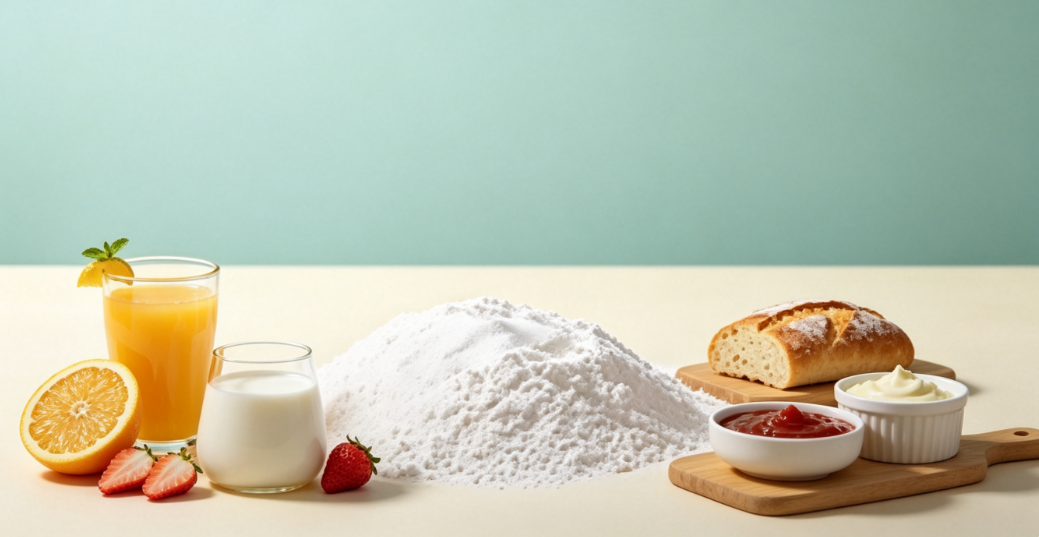

Food-grade sodium carboxymethyl cellulose (CMC-Na, E466) is a widely used thickener, stabilizer, water-retaining agent and emulsifier in the food industry. It is commonly applied in beverages, ice cream, baked goods, sauces, meat products and other categories. Though all are labelled as food-grade CMC, products differ greatly in performance due to variations in raw materials, production processes and quality control. A poor choice will not only impair the texture and shelf life of your end products, but also bring potential food safety risks. With a scientific selection method, you can source premium raw materials steadily. Fortune Biotech sorts out core selection criteria for you.
1. Verify Compliance Certifications to Secure Food Safety
For food additives, safety is always the top priority. Qualified food-grade CMC must meet regulatory standards for target markets: domestic supplies comply with GB 1886.232, while export grades conform to FCC, USP and EU food regulations.
During procurement, check valid full-set certificates, including ISO22000, FSSC22000, BRC, Halal and Kosher certifications. Request the Certificate of Analysis (COA) for each batch to inspect heavy metals, microorganisms, arsenic, lead and other hazardous substances. Avoid suppliers with unclear credentials, reused certificates or no batch test reports. Fortune Biotech holds complete certifications. Full test documentation is available for every batch, supporting market access in China, Southeast Asia, Europe, America and other regions.
2. Understand Key Physicochemical Indicators to Evaluate Intrinsic Quality
Many buyers only focus on viscosity. In fact, degree of substitution (DS), purity, viscosity, particle size and dissolution behavior jointly determine CMC performance in formulations.
- Degree of Substitution (DS): The mainstream range for food-grade CMC is 0.6–0.95. CMC with uniform and stable DS dissolves quickly without lumping, and delivers better acid and salt tolerance. Products with low or uneven DS tend to dissolve incompletely, stratify or precipitate, and fail easily in acidic drinks and fermented foods.
- Purity: High-quality food-grade CMC has a dry-basis purity of ≥99.5% with minimal impurities. Low-purity grades contain excessive salts and by-products, which destabilize the system and alter flavor and color.
- Viscosity Graded by Application: Higher viscosity is not always better. Select specifications according to your needs. Low viscosity for clear beverages and syrups; medium viscosity for sauces, fillings and plant-based milk; high viscosity for ice cream, flour products and meat to retain water, inhibit ice crystal growth and improve dough structure.
- Powder Appearance & Dispersibility: Premium CMC is uniform white or off-white powder free of agglomerates and dark specks. Grades with optimized particle size hydrate rapidly, reduce clumping during mixing and suit automatic production lines.
3. Match Grades with Application Scenarios and Formulation Compatibility
There is no universal CMC grade. A CMC optimized for ice cream may not work well in acidic fruit juice.
- Ice cream & frozen desserts: Anti-ice-crystal type to restrain crystal growth for smooth, fine texture
- Acidic beverages & yogurt: Acid-resistant grade to maintain stable viscosity at low pH and prevent sedimentation and stratification
- Baked goods & flour products: Water-retention type to strengthen dough structure, retard staleness and extend shelf life
- Condiment sauces: Stabilizing grade to suspend solids, avoid oil-water separation and deliver natural coating property
Drawing on years of R&D experience in cellulose derivatives, Fortune Biotech develops application-specific food-grade CMC series. We offer customized viscosity and DS solutions for client formulations, and our technical engineers provide formulation support to cut your trial-and-error costs.
4. Assess Factory Production & QC Capability for Batch Consistency
Batch fluctuation is a major headache for food manufacturers. Unstable viscosity and poor solubility between batches may lead to production waste. Consistent high-quality CMC relies on closed automated production lines, stable wood pulp sources and closed-loop quality control. The factory needs an independent laboratory to test raw materials, semi-finished goods and finished products across all processes and tightly control process parameters.
Fortune Biotech specializes in the manufacturing of CMC derivatives. Our automated production lines ensure stable output. We serve more than 3,000 customers across over 60 countries worldwide, guaranteeing consistent quality batch after batch for large-volume orders. We also support exhibition participation and preparation of compliance documents for overseas markets.
5. Value Technical Support for Long-Term Partnership
A reliable supplier is more than a powder vendor; it is your partner for food ingredient solutions. Beyond stable supply, qualified suppliers provide sample testing, formulation optimization, process consultation and troubleshooting when you encounter issues such as lumping, stratification or unsatisfactory texture.
Conclusion
The priority sequence for selecting high-quality food-grade sodium carboxymethyl cellulose is: verify safety compliance first, check physicochemical indicators second, match grades to applications, confirm batch consistency, and finally evaluate the supplier’s technical service capacity.
Fortune Biotech is dedicated to cellulose derivatives. We supply high-standard food-grade CMC with rigorous quality control and customized technical solutions, helping global food manufacturers stabilize product quality and deliver superior end-food experiences. Feel free to contact us for samples and technical inquiries.